
 Residence
  Location
Insect Bed Bugs
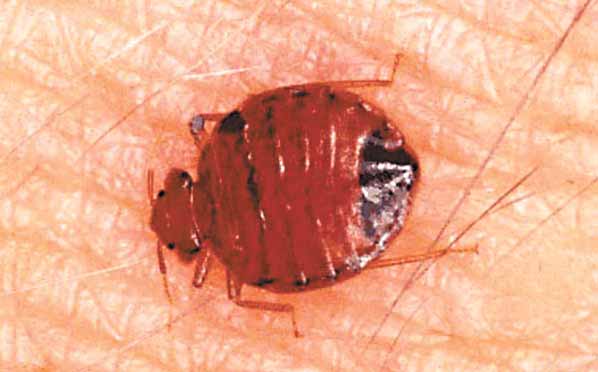
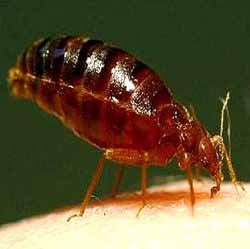
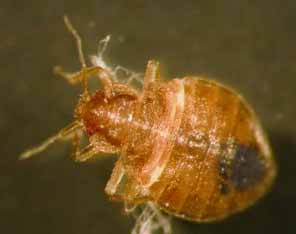
 Bed bugs are small, oval, non flying insects that belong to the insect familyCimicidae, which includes three species that bite people. Adult bed bugs reach 5-7 mm in length, while nymphs (juveniles) are as small as 1.5 mm. Bed bugs have flat bodies and may sometimes be mistaken forticksor small cockroaches. Bed bugs feed by sucking blood from humans or animals. Adult bed bugs are reddish brown in color, appearing more reddish after feeding on a blood meal. Nymphs are clear in color and appear bright red after feeding. The wings of bed bugs are vestigial, so they cannot fly.
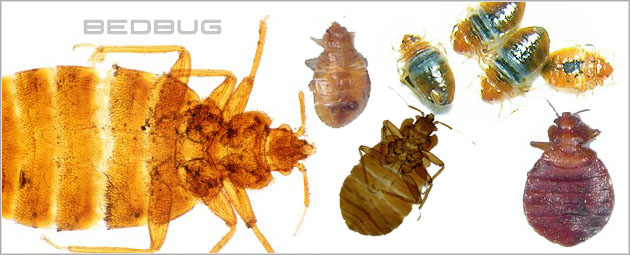
Several different kinds of insects resemble bed bugs, specimens should be carefully compared with good reference images to confirm their identity. If any questions remain regarding the identity of your samples, then submit them to a competent entomologist for evaluation. Bed bugs bite with piercing and sucking mouthparts, similar to mosquitoes and bites result in local swelling and irritation like abad mosquito bite. However, unlike some other blood-feeding insects bed bugs probably arenotimportant carriers of human disease. While digesting a meal bed bugs excrete black fecal material (digested blood) that accumulates where they hide and is characteristic of an infestation.
 Since bed bugs don't fly, and not able to walk very far on their own, these bugs rely on us to move them from one place to another. Rooms generally become infested because bed bugs are carried into the room on our belongings. The bugs can hide themselves in pillows, blankets, sleeping bags, backpacks, towels, clothing, and so forth, when transported from an infested to an uninfested room.
Bed bugs are bloodsucking insects. They are normally out at night just before dawn, with a peak feeding period of about an hour before sunrise. Bed bugs may attempt to feed at other times if given the opportunity and have been observed feeding during all periods of the day. They reach their host by walking, or sometimes climb the walls to the ceiling and drop down on feeling a heat wave. Bed bugs are attracted to their hosts by warmth and the presence ofcarbon dioxide. The bug pierces the skin of its host with two hollow feeding tubes. With one tube it injects its saliva, which containsanticoagulantsandanesthetics, while with the other it withdraws the bloodof its host. After feeding for about five minutes, the bug returns to its hiding place. The bites cannot usually be felt until some minutes or hours later, as a dermatological reaction to the injected agents, and the first indication of a bite usually comes from the desire to scratch the bite site. Because of their natural aversion for sunlight, bed bugs come out at night.
 Bed bugs were originally brought to theUnited Statesby early colonists fromEurope. Bed bugs thrive in places with high occupancy, such as hotels. Bed bugs were believed to be altogether eradicated 50 years ago in the United States and elsewhere with the widespread use of DDT. One recent theory about bed bug reappearance involves potential geographic epicentres. Investigators have found three apparent United States epicentres at poultry facilities inArkansas,Texas, andDelaware. It was determined that workers in these facilities were the main spreaders of these bed bugs, unknowingly carrying them to their places of residence and elsewhere after leaving work. Bed bug populations in the United States have increased by 500 percent in the past few years. The cause of this resurgence is still uncertain, but most believe it is related to increased international travel and the use of new pest-control methods that do not affect bed bugs. In the last few years, the use of baits rather than insecticide sprays is believed to have contributed to the increase.[citation needed]With the advent ofcockroachbait in the early 1990s, the use of residual insecticides and other liquid sprays were drastically reduced. As it turned out, pest control professionals had not realized that during their monthly treatments for cockroaches (particularly the German cockroach,[citation needed]which infests hotels as bed bugs do) they had helped in the control of bed bugs. This process may have started with the use of DDT but it is no coincidence that the dramatic rise in bed bug activity came approximately 10 or so years after professionals stopped spraying for cockroach activity.

 Bed bugs are small wingless insects that feed solely upon the blood of warm-blooded animals. Bed bugs and their relatives have evolved as nest parasites. Certain kinds inhabit bird nests and bat roosts and await the return of their hosts; others have adapted well to living in the '˜nests' (homes) of people. Hatchling bed bugs are about the size of a poppy seed, and adults are about 1/4 of an inch in length. From above they are oval in shape, but are flattened from top to bottom.
 Bed bugs can infest all kinds of different places in your bedroom. Most often they're in the mattress - in the seams, the box springs, or sometimes the linens. However, they can really be anywhere near where people sleep - furniture within crawling distance, carpet, books, phones - they've been found in all kinds of random things, because they don't create a nest, they just hide somewhere.
 Over 80% of bed bug infestations are found in the mattress or box spring! You can be pro-active and take preventative steps to avoid bed bug infestations in your home by protecting your bedding. The problem with bed bugs is that they infiltrate every aspect of your family's life. Even the most basic necessity, a good night's rest, can no longer be taken for granted. With the rapid increase in bed bug infestation, bed time is now fraught with anxiety. Read the tips below and learn what steps to take to protect your home and family.
  And in cities like New York, where neighbors are often separated only by bricks and mortar, one person's infestation is everybody's problem, since bed bugs can crawl through walls and along wiring and pipes, and hitchhike on clothing, furniture, luggage and more. In this city of 8.3 million, it seems as if everyone has a bed bug story. Just ask Gale A. Brewer, a self-appointed bed bug evangelist and a City Council member from the Upper West Side. She prodded the Mayor's office to convene a bed bug advisory committee last fall, after years of what she and others felt were woeful public policy inadequacies in the face of the relentless advances of what some have called 'œthe pest of the century.' (The committee '” entomologists, civic policy experts and advocates for children, the elderly and others '” will issue its recommendations next month.)
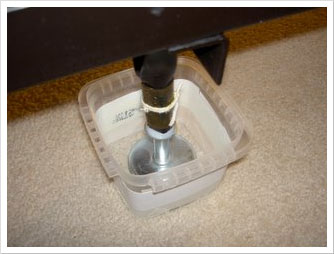 Due to the difficulty in eliminating the bugs from the room or dwelling, the (suspected) bed is isolated, thus removing the insects' food source'”humans. Bedbugs cannot crosspetroleum jellyand have difficulty climbingmetalorglass, hence each of the bed legs is put in atincan(the bottom of which is thickly coated with petroleum jelly) to avoid movement from the bed to the hiding places. Although bedbugs cannot fly, they have been observed climbing a higher surface in order to then fall to a lower one, such as climbing a wall in order to fall onto a bed. They can also jump a few centimeters, and so could jump from the wall onto the nearby bed. Hence alternatively, a double-sided stickytape(such as carpet tape) is applied around each bed leg, or to keep each leg on a plastic furniture block in a tray of water. However, this does not prevent bugs from biting you on your couch or in other areas of your dwelling.
 A disinfected bed can be isolated and protected by applying a layer of duct tape around each leg of the bed'”using regular duct tape that has been curled lengthwise over on itself with the sticky side out. This creates a simple yet sticky barrier that will prevent most bedbugs from being able to crawl up the legs and onto the bed. This barrier technique may also be used in multiple strips or rows placed side by side to create an even stronger barrier (in areas where an infestation is heavy or where there exists a higher chance that bedbugs will attempt to crawl over the sticky tape). However, in using duct tape as a barrier, it is usually necessary to first place down a protective layer of some sort to prevent the duct tape from damaging the surfaces adhered to as well as to the prevent the duct tape barrier from leaving behind a sticky residue once it is finally removed. This protective layer, if used, can be created by placing a layer of painter's tape (also called masking tape) around the legs of the bed first'”before placing the duct tape. The painter's tape will help protect the surfaces wherever the 'curled duct tape' barrier is placed as the duct tape is adhered only directly over top the protective layer of painter's tape. Also, as a substitute to masking tape, plastic wrap can be wrapped tightly around the legs of a bed and used as the initial protective layer instead (where the curled duct tape is then placed over the plastic wrap).
 Bed bugs provide an interesting and compelling example of a conflict of interest between mates. Generally, scientists have assumed that both male and female parents have similar interests in reproduction. However, bed bugs mate in a peculiar manner that is advantageous for males but downright dangerous for females. The genitalia of the female bed bug do not function in copulation. Instead, the male injects sperm through the abdominal wall into a paragenital organ, a phenomenon known as traumatic insemination. Traumatic insemination wounds the females and may also result in infection.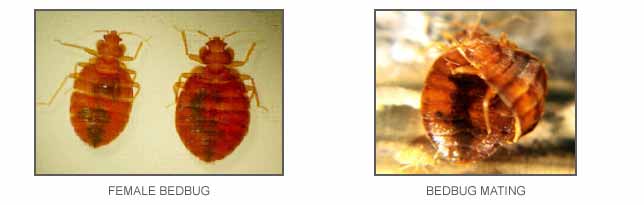
 MaleCimex lectulariusproduce an abdominal wound in females during mating, a phenomenon that is likely to be costly to females. To investigate the fertilizing capacity of a single copulation, 20 virgin females each received a single copulation from a virgin male. The number and proportion of fertile eggs produced were counted over eight clutches (one clutch per week). Virgin females where allocated at random to one of two experimental treatments. In the first treatment group, females were allowed to copulate once with a virgin male (allocated at random), whereas in the second treatment group, females were allowed to copulate once with each of five virgin males (allocated at random). Females then were isolated and fed at weekly intervals, and the eggs were collected for five clutches.
  With the widespread use ofDDTin the 1940s and'50s, bed bugs mostly disappeared from North America in the mid-twentieth century .Infestations remained common in many other parts of the world and in recent years have also begun to rebound in North America. Thanks to rises in rampant hoarding around the United States,[clarification needed]bed bugs are able to hide and reproduce without immediate detection. Reappearance of bed bugs has presented new challenges for pest control due to their developed resistance to various pesticides including DDT, and organophosphates.In fact, using DDT on today's bed bug makes it more active.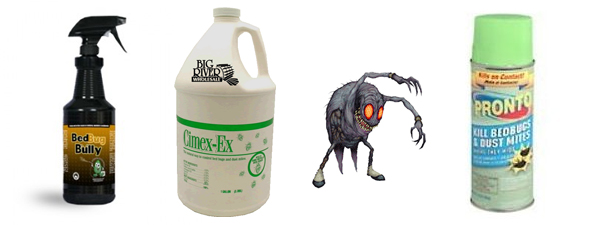
 Available in the market are several pesticides to control bed bugs. The list of pesticides for the purpose can be a long one, and you may easily access them or buy them in the market. But professional help from pest control operators are necessary because small failures and mistakes in applying pesticides to control bed bugs may cause more serious problems. The list of pesticides to control bed bugs is ever growing. Every year a handful of additional insecticides make the list longer. This acknowledges how people are concerned with the increasing annoyance and discomfort from having bed bugs at home.