 Residence
  Location
Categories
- Bed Bug
- Bed Bug Cream
- BED BUG DATABASE
- Bed Bug Home Remedies
- Bed Bug Oil
- Bed Bug Remedies
- Bed Bug Spray
- Bed Bugs New York
- Bed Bugs Vancouver
- Bed Bugs World
- Bed Bugs American Samoa
- Bed Bugs Canada
- Bed Bugs Guam
- Bed Bugs North Mariana islands
- Bed Bugs Puerto Rico
- Bed Bugs United States
- Bed Bugs Alabama
- Bed Bugs Alaska
- Bed Bugs Arizona
- Bed Bugs Arkansas
- Bed Bugs California
- Bed Bugs Colorado
- Bed Bugs Connecticut
- Bed Bugs Delaware
- Bed Bugs Florida
- Bed Bugs Georgia
- Bed Bugs Hawaii
- Bed Bugs Idaho
- Bed Bugs Illinois
- Bed Bugs Indiana
- Bed Bugs Iowa
- Bed Bugs Kansas
- Bed Bugs Kentucky
- Bed Bugs Louisiana
- Bed Bugs Maine
- Bed Bugs Maryland
- Bed Bugs Massachusetts
- Bed Bugs Michigan
- Bed Bugs Minnesota
- Bed Bugs Mississippi
- Bed Bugs Missouri
- Bed Bugs Montana
- Bed Bugs Nebraska
- Bed Bugs Nevada
- Bed Bugs New Hampshire
- Bed Bugs New Jersey
- Bed Bugs New Mexico
- Bed Bugs New York
- Bed Bugs North Carolina
- Bed Bugs North Dakota
- Bed Bugs Ohio
- Bed Bugs Oklahoma
- Bed Bugs Oregon
- Bed Bugs Pennsylvania
- Bed Bugs Rhode Island
- Bed Bugs South Carolina
- Bed Bugs South Dakota
- Bed Bugs Tennessee
- Bed Bugs Texas
- Bed Bugs Utah
- Bed Bugs Vermont
- Bed Bugs Virgin Islands
- Bed Bugs Virginia
- Bed Bugs Washington
- Bed Bugs Washington DC
- Bed Bugs West Virginia
- Bed Bugs Wisconsin
- Bed Bugs Wyoming
- BedBug Removal
- BedBugs in Michigan
- Canada Bed Bugs
- Do it yourself Bed Bug
- Exterminator Bed Bugs
- Health
- Pest Inspection
- Toronto Bed Bugs
- Welcome to Bed Bugs
Registry Sites List
- Bronx Bed Bug Registry Infestation Maps, Residential And Hotel
- Brooklyn Bed Bug Registry Infestation Maps, Residential And Hotel
- Manhattan Bed Bug Registry Infestation Maps, Residential And Hotel
- Nyc Bed Bug Registry Infestation Maps, Residential And Hotel
- Queens Bed Bug Registry Infestation Maps, Residential And Hotel
- Staten Island Bed Bug Registry Infestation Maps, Residential And Hotel
Recommended Sites
Category Archives: Bed Bugs World
News Links:
Bed Bugs – UF/IFAS Extension: Solutions for Your Life
Bed bugs are blood feeding insects that feed on humans, usually during night hours when people are sleeping. Since we do not often observe bed bugs biting, it is easy to mistake the itchy, swollen areas on the skin for other insect bites. While the bites can become infected from scratching, bed bugs are not known to transmit any diseases; however, they are still a nuisance and serious pest problem.
Despite their name, bed bugs can infest areas other than beds. They tend to locate in cracks and crevices, such as behinds baseboards, wall outlets, and wallpaper; between bed joints, slats, and dresser drawers; and along mattress seams and in linens and clothes. Most bed bug infestations occur in the home, along with hotels, dormitories, and cruise ships.
Bed bugs easily transfer from one site to another through infested belongings like clothes, suitcases, second-hand furniture, beds, and bedding.
Adult bed bugs can survive 6-7 months without feeding, and have been known to live in abandoned houses for 1 year. This, combined with the fact that females lay 2-5 eggs a day (and 200-500 eggs in her lifetime), means that bed bug infestations will not go away without proper treatment.
Bed bugs are difficult to detect because of their elusive behavior, but here are some key things to look for:
There are several ways to get rid of bed bugs, though combining methods usually gives the best result. Since the bugs often hide in small cracks, treatment can be difficult, making it worth hiring a pest control specialist. Even if you hire a professional to inspect and treat your home, there are important steps for you to take as well.
Physically remove as many bed bugs as possible:
Sometimes treatment will require the use of insecticides. Dusts are preferred over sprays for bed bug treatments because dusts transfer from surfaces easier, are lighter, and penetrate further than sprays. Insecticides are used and classified according to four categories: Mattress, Crack, and Crevice; Indoor Surface; Indoor Space; and Fumigation.
Methods for non-chemical treatment involve physical removal and heat. In addition to the removal guidelines outlined above, mattresses, pillows, and box springs can be put in bed bug proof encasements. Make sure the labels say bite proof as well as escape proof.
Bed bugs begin to die at temperatures above 113F, so using high temperature when laundering or steaming infested items is another way for non-chemical control. Pest control companies also offer heat treatment for bed bugs. Methods can involve using polystyrene board insulation around items to be treated and heating these boxes to the appropriate temperatures with space heaters, or using commercial heaters to heat the entire room and its contents.
Bed bugs are not often removed with one treatment, and continued inspections and treatment follow ups are key for eliminating an infestation.
Awareness of bed bugs and their habits is the most important way to avoid infestations. When traveling or exchanging belongings, know what to look for to assure bed bugs are not present.
Visit the Florida Bed Bug Workgroup website to view articles, videos, and links about bed bugs and their prevention and treatment.
Read the original here:
Bed Bugs - UF/IFAS Extension: Solutions for Your Life
Posted in Bed Bugs Florida
Comments Off on Bed Bugs – UF/IFAS Extension: Solutions for Your Life
Fleas, Ticks, Bed Bugs Exterminator Pest Control Company …
Fleas: What They Are, What To Do
There are over 2,000 described species of fleas in the world. The most common domestic flea is the cat flea (Ctenocephalides felis felis).
The dog flea (Ctenocephalides canis) appears similar to the cat flea, but is rare in the United States. The sticktight flea (Echidnophaga gallinacea) can become a problem if pets frequent areas associated with poultry.
Eggs are oval, and smooth . They are tiny (0.5mm), but visible to the naked eye. Their white color may prevent them from being seen on lightly colored fabric. Small wormlike larvae (1.5-5 mm in length) hatch from the eggs. They are also visible to the naked eye.
They are eyeless, legless and sparsely covered with hairs. The larval body is translucent white with a dark colored gut that can be seen through the skin. These immature fleas will eventually spin silken cocoons in which they will develop (pupate) into adult fleas. Cocoons are sticky, attracting dirt and debris.
This camouflage may prevent them from being seen. Adults are about 1-3 mm in length, reddish-brown to black, wingless, and laterally compressed Their powerful hind legs are well adapted for jumping and running through hair and feathers.
Flea Life Cycle & Biology
Cat flea adults, unlike many other fleas, remain on their host. Females require a fresh blood meal in order to produce eggs, and they can lay up to 1 per hour! The smooth eggs easily fall from the pet onto the carpet, bedding, or lawn.
Adult fecal matter consists of relatively undigested blood. This dried blood also falls from the pet and serves as food for the newly hatched larvae. The young fleas will hatch within 2 days and feed on dandruff, grain particles, and skin flakes found on the floor around them, in addition to the fecal matter provided by adult fleas.
They prefer to develop in areas protected from rainfall, irrigation, and sunlight, where the relative humidity is at least 75% and the temperature is 70-90F. The larval stage lasts 5-15 days.
Flea life cycle.
Larvae spin silken cocoons within carpet fibers, floor crevices, or protected outdoor areas in which they will develop (pupate) into adult fleas. The cocoons are sticky and easily camouflaged by local debris. Under optimal conditions, new adults are ready to emerge within 2 weeks. They develop faster at higher temperatures, but can remain in their cocoons up to 12 months. Vibrations and/or an increase in carbon dioxide stimulate adults to emerge. Adults live 4-25 days and are the only stage that lives on the pet and feeds on fresh blood.
The cat flea is capable of transmitting plague and murine typhus to humans, but reports of such are rare; its primary importance is its nuisance to humans and pets. They are not picky about their meals; any warm-blooded animal will do. Bites usually cause minor itching, but may be more irritating to those with sensitive skin. Some people and pets suffer from flea allergy dermatitis, lasting up to 5 days and characterized by intense itching, reddening at the bite site, hair loss, and secondary infection.
Cat fleas also serve as intermediate hosts of the dog tapeworm (Dipylidium caninum). This intestinal parasite is transmitted to the pet while grooming via ingestion of an adult flea carrying a tapeworm cyst. The flea is infected by ingestion of the cyst during its larval stage. The parasite segments resemble small pieces of rice and may be discovered around the anal region of your pet.
Effective control requires eradication of fleas from the pet, the home, the yard, and control of the flea life cycle. Removal of fleas from the pet alone is futile; immature fleas (eggs, larvae, pupae) develop off the pet and new adults simply jump on, causing subsequent reinfestation.
New and safe products are available that can be used as part of a reduced chemical control program. There are also ways of making the environment less suitable for flea development.
Flea control is a three part process:
Removing fleas from pets may be done by a veterinarian, grooming parlor, or by the pet owner on the day of treatment, either before or while the premises are being treated. A flea comb may be used, but is not very effective for removing fleas; only 10-60% will be collected. Fleas should be dropped in soapy water and then discarded. This method is very time consuming, though, and most pet owners prefer to shampoo their pets.
Shampooing your pet removes the dried blood and skin flakes that fall to the ground and serve as food for flea larvae. The animal's body must be thoroughly lathered, and it is recommended that the lather remain for up to 15 minutes before the pet is rinsed.
Flea shampoos contain various insecticides: Pyrethrins are derived from the chrysanthemum plant and kill fleas on the animal quickly. Pyrethroids are synthetically derived from pyrethrins and have better residual action. Both of these are usually enhanced with piperonyl butoxide, a compound which will inhibit the fleas from metabolically changing the insecticide into nontoxic, excretable compounds. Carbamate insecticides are also available for use in shampoos. Citrus peel derivatives, such as D-limonene, are also added to shampoos and are fairly mild, making them excellent for use on puppies andkittens, as well as in households with infants. Some pets however, especially cats, may exhibit allergic reactions to this type of product. Pennyroyal oil, another natural product, is also available in shampoos. Pulegone, the active ingredient in this oil, has dose related toxicity to mammals and may induce lethargy, vomiting, diarrhea, nose bleeds, seizures, and, possibly, death due to liver failure. There is no antidote to pulegone poisoning . Label directions and cautions should be carefully followed when using this type of product. Mixing your own shampoo with pure oil is not recommended.
The newest advances in topical flea control applications are imidacloprid (Advantage) or fipronil (Frontline). Both are available as spot-on oils which are applied to the shoulder area of the pet and distribute over the body within a few hours. They are non-toxic to mammals and kill almost all fleas on the pet within 24 hours of treatment. Dogs and cats treated with imidacloprid have approximately 95% control for 3 weeks and then 80% control the fourth week. Fipronil kills 98% of the fleas on dogs and cats for 4 weeks, and efficacy continues for up to 8 weeks on dogs, but drops down to 80% protection on cats by sixth week. Fipronil also kills ticks on the animal for up to one month. If your pet displays flea allergy dermatitis take note: approximately 90% of the fleas on pets treated with either product fed (bit the pet) before their death. These fleas were also able to produce viable eggs. This means that while these products help reduce the symptoms of flea allergy dermatitis by killing fleas and reducing the number of flea bites on the animal, there may still be some allergic reaction because fleas are able to bite before dying. This blood meal will also enable them to reproduce.
Insect growth regulators (IGRs) and insect development inhibitors (IDIs) work by interfering with egg development and molting of adolescent fleas. They control the flea life cycle but do not kill adult fleas. Methoprene (Precor) and pyriproxyfen (Nylar, Archer) are IGRs available for pet treatment in sprays and flea collars. Lufenuron (Program), an IDI, is orally administered to the pet. These products do not take immediate effect because they target flea eggs and larvae. Use of one of these products along with use of Advantage or Frontline will kill adults and prevent development of immature fleas.
Scientific evidence regarding dietary supplementation with vitamin B, Brewer's yeast, or garlic suggest these methods are of little value.
Ultrasonic flea collars have also been proposed for use to keep fleas off pets, but are completely ineffective. Insecticidal flea collars also are not very effective.
Indoor treatment should be concentrated on areas frequented by your pets; this is where most of the eggs and larvae will be located. Vacuum the entire house and dispose of the vacuum bag immediately there will be developing fleas inside! Vacuuming will remove flea eggs and stimulate new adults to emerge from their cocoons, exposing them to any insecticide residue on the floor. Also, vacuuming may not pick up any larvae due to their ability to wrap around and hold on to carpet fibers. Steam cleaning carpets is even more effective than normal vacuuming and should be considered if infestation is severe. Wash pet's bedding and throw rugs. Sprays or foggers containing an insecticide and insect growth regulator should be applied according to label directions after vacuuming. Borate carpet treatment, applied either by the homeowner or a professional exterminator, works as intestinal poison upon ingestion by flea larvae. The powder is sprinkled and worked into the carpet. Overall risk of danger to pets and humans is unknown, but appears to be low. This treatment, however, is not recommended for homes with infants. Diatomaceous earth has also been used as a chafing agent to control larvae in carpets, but it contains silica which is known to cause lung disease in humans if inhaled in excessive quantity.
Light traps placed around the home, especially where the pet frequents, may collect fleas upon emergence from their cocoons. Adult fleas have been noted to orient themselves toward light and jump when light is interrupted, as though the shadow signals passing of an unsuspecting host. Tests indicate they prefer yellow-green light (525nm) that remains on for 10 minutes and flashes off for 5 seconds. However, it is doubtful that this trap will attract fleas off your pet.
Cedar chips and leaves from wax myrtles may have some repellent properties (some people swear by them!), but have not been scientifically proven.
Restrict pet access from areas that are hard to treat, such as children's playrooms, crowded garages or work areas.
Flea larvae develop in shaded, humid areas, but will drown in a flooded environment. Rainfall is often enough to curb larval development outdoors. In addition to drowning, the fecal dried blood meal provided by adult fleas is no longer available if the lawn is wet. Loose debris and weeds should be removed and the lawn mowed to expose their environment. Sprays containing insecticides registered for outdoor use, such as pyrethroids, may be applied during dry seasons every 2-3 weeks to shaded areas where pets frequent. Insect growth regulators are also available for outdoor use. Pyriproxyfen (Archer, Nylar) is the most effective outdoor treatment; it is very stable and provides protection against developing fleas for approximately 7 months. Methoprene (Siphotrol, Precor) is also commonly used outdoors, but is not stable in sunlight. Larvae prefer shaded dry areas, so spraying the entire yard is wasteful and irresponsible. If possible, control access of feral animals (opossums, skunks, etc.) to your yard as they bring new fleas with them.
Sheds and dog houses should be treated the same as the house. Biological control using the beneficial nematode Steinernema carpocapsae has been investigated in several areas around the United States. These nematodes are applied to the lawn as a spray and destroy the flea larvae (and other insects) by parasitizing them. They do not attack people, pets, or plants. This treatment should reduce flea populations if label directions are carefully followed. In fact, just spraying the yard with water is enough to reduce flea populations! The nematode treatment is probably not needed.
Restricting pet access from areas that are difficult to treat (e.g., beneath porches, inside crowded sheds) may also help flea control.
Detection is as simple as seeing fleas on your pet, noticing your pets scratching, or flea bites around your ankles. Perhaps there are small black pieces of dirt covering your pet's bedding, or perhaps you've noticed tapeworm segments near or on your pet. The black dirt is the adult flea feces left behind to serve as food for larvae, and tapeworms are transmitted by ingestion of fleas.
Monitoring is more difficult than simple detection. Fleas reproduce rapidly (one female can produce up to one egg per hour throughout her 4 week adult life), so if you spot one flea there are probably more. Combing your pet or wearing white socks around the house are also ways to determine severity of the infestation.
Q: My daughter gets bitten by fleas while I am never bothered. Why is this?
A: Blood feeding insects are attracted to chemicals emitted from the body (sweat, exhalation, etc.). Some people just smell more attractive than others to certain insects. Individual sensitivity to the bite is another reason. To some, flea bites are extremely irritating while other people hardly notice them. This is caused by an allergic response to the flea saliva and occurs in varying degrees among people.
Q: I have bombed my house for fleas three times this month and still have them. Why?
A: It is likely that you are seeing adults emerge from cocoons that were produced before you bombed. The cocoons are deep within the carpet and treatment may not have reached them. If you did not treat your yard new fleas may be coming indoors on you or your pets. If the foggers you used contained pyrethrins or pyrethroids, you probably only killed larvae and adults. Insect growth regulators are available in foggers and will prevent development of immature fleas.
Q: I just moved into a new apartment. It is infested with fleas. Where did they come from and what can I do?
A: The people living there before you probably had a pet. Even if the apartment was treated with insecticides before you moved in, the treatment may not have penetrated the carpet to kill developing pupae. Treatment is described above.
Q: When we go on vacation, we board our dogs at the kennel and leave the house closed up for three weeks. As soon as we get home we are attacked by fleas. The dogs have been away. What is going on?
A: The fleas that were in the egg and larval stage have pupated and matured and were waiting in their cocoons for the proper stimulation to emerge (vibration, carbon dioxide). In order to keep this from happening, next time treat your home with an insecticide that kills adult fleas and an insect growth regulator to prevent immature fleas from developing.
Q: What is the difference between dog fleas and cat fleas?
A: Cat fleas are the main flea on both cats and dogs in North America. Dog fleas are found in Europe. They are distinguished by a slight morphological difference which is only detectable under high magnification.
Q: What are sand fleas?
A: "Sand fleas" or "beach fleas" are common names for small orange amphipods found along the beach. They are distant relatives of true fleas, and are not even insects (they have more than six legs). Also, some people may refer to fleas that just happen to be developing in sandy areas as "sand fleas".
1. This document is ENY-291, one of a series of the Entomology and Nematology Department, Florida Cooperative Extension Service, Institute of Food and Agricultural Sciences, University of Florida. First published: March 1997. Revised: July 2007. Please visit the EDIS Website at http://edis.ifas.ufl.edu.
2. D. L. Richman, graduate assistant, and P. G. Koehler, professor, Department of Entomology and Nematology, Cooperative Extension Service, Institute of Food and Agricultural Sciences, University of Florida, Gainesville, 32611.
Back to Top
Sometimes referred to as "red coats," "chinches," or "mahogany flats" (USDA 1976), bed bugs, Cimex lectularius Linnaeus, are blood feeding parasites of humans, chickens, bats and occasionally domesticated animals (Usinger 1966).
Bed bugs are suspected carriers of leprosy, oriental sore, Q-fever, and brucellosis (Krueger 2000) but have never been implicated in the spread of disease to humans (Dolling 1991). After the development and use of modern insecticides, such as DDT, bed bug infestations have virtually disappeared.
However, since 1995, pest management professionals have noticed an increase in bed bug related complaints (Krueger 2000).
Adult bed bug, Cimex lectularius Linnaeus
Human dwellings, birds nests, and bat caves make the most suitable habitats for bed bugs since they offer warmth, areas to hide, and most importantly hosts on which to feed (Dolling 1991). Bed bugs are not evenly distributed throughout the environment but are instead concentrated in harborages (Usinger 1966). Within human dwellings, harborages include cracks and crevices in walls, furniture, behind wallpaper and wood paneling, or under carpeting (Krueger 2000).
Bed bugs are usually only active during night but will feed during the day when hungry (Usinger 1966). Bed bugs can be transported on clothing, in traveler's luggage, or in bedding and furniture (USDA 1976) but lack appendages to enable them to cling to hair, fur, or feathers, so are rarely found on hosts (Dolling 1991).
The adult bed bug is a broadly flattened, ovoid, insect with greatly reduced wings (Schuh and Slater 1995). The reduced fore wings, or hemelytra, are broader than they are long, with a somewhat rectangular appearance. The sides of the pronotum are covered with short, stiff hairs (Furman and Catts 1970). Before feeding, bed bugs are usually brown in color and range from 6 to 9.5 mm in length. After feeding, the body is often swollen and red in color (USDA 1976).
The two bed bugs most important to man are the common bed bug, Cimex lectularius, and the tropical bed bug, Cimex hemipterus. These two species of bed bugs can easily be distinguished by looking at the prothorax, the first segment of the thorax. The prothorax of the common bed bug is more expanded laterally and the extreme margins are more flattened than that of the tropical bed bug (Smith 1973).
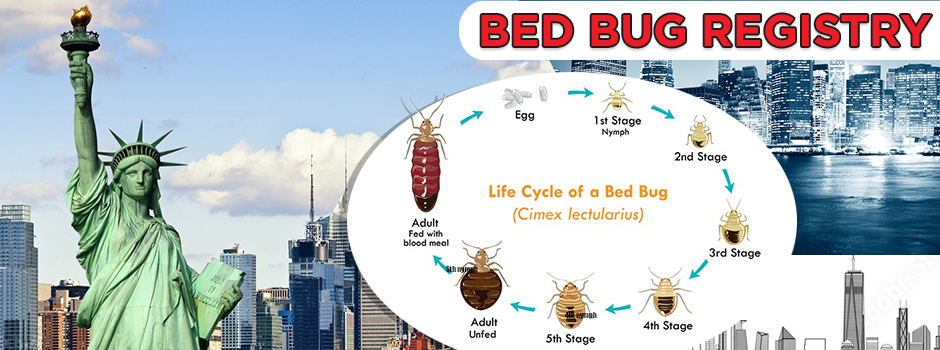
Because of their confined living spaces, copulation among male and female bed bugs is difficult. The female possesses a secondary copulatory aperture, Ribaga's organ or paragenital sinus, on the fourth abdominal sternum where spermatozoa from the male are injected. The spermatozoa then migrate to the ovaries by passing through the haemocoel, or body cavity (Dolling 1991). The female bed bug lays approximately 200 eggs during her life span at a rate of one to 12 eggs per day (Krueger 2000). The eggs are laid on rough surfaces and coated with a transparent cement to adhere them to the substrate (Usinger 1966). Within six to 17 days bed bug nymphs, almost devoid of color, emerge from the eggs. After five molts, which takes approximately ten weeks, the nymphs reach maturity (USDA 1976).
Bed bugs are most active at night, they are extremely shy and wary so their infestations are not easily located (Snetsinger 1997). However, when bed bugs are numerous, a foul odor from oily secretions can easily be detected (USDA 1976). Other recognizable signs of a bed bug infestation include excrement left around points of entry and exit to their hiding places (Dolling 1991) and reddish brown spots on mattresses and furniture (Frishman 2000). Good sanitation is the first step to controlling the spread of bed bugs. However, upscale hotels and private homes have recently noted infestations, suggesting that good sanitation is not enough to stop a bed bug infestation (Krueger 2000).
If bed bugs are located in bedding material or mattresses, control should focus on mechanical methods of control, such as vacuuming, caulking and removing or sealing loose wallpaper, to minimize the use of pesticides (Frishman 2000). The effectiveness of using steam cleaners or hot water to clean mattresses is questionable. Heat is readily absorbed by the mattress and does no harm to the bed bug in fact the moisture may produce favorable conditions for house dust mites. Pillows should be removed and dry-cleaned or replaced (Snetsinger 1997). For severe infestations, however, pesticides may be used. Care should be taken not to soak mattresses and upholstery with pesticides. Allow bedding and furniture to dry throughly before using.
For more information, see the Insect Management Guide for Bed Bugs (http://edis.ifas.ufl.edu/IG083).
Dolling WR. 1991. The Hemiptera. Oxford University Press, New York, New York.
Fasulo TR. 2002. Bloodsucking Insects. UF/IFAS SW 156.
Fasulo TR, Kern W, Koehler PG, Short DE. 2005. Pests In and Around the Home. Version 2.0. UF/IFAS CD-ROM. SW 126.
Frishman A. 2000. Bed Bug basics and control measures. Pest Control 68:24.
Furman DP, Catts E. 1970. Manual of Medical Entomology, 3rd ed. National Press Books, Palo Alto, California.
Ghauri MSK. 1973. Hemiptera (bugs), pp. 373-393. In K.G.V. Smith [ed], Insects and other Arthropods of Medical Importance. British Museum, London, England. [USDA] U.S. Department of Agriculture. 1976. How to control bed bugs. USDA. Washington D.C.
Koehler PG, Hertz J. 2005. Bed bugs and blood-sucking conenose. EDIS. "http://edis.ifas.ufl.edu/IG083 (9 December 2005).
Krueger L. 2000. Don't get bitten by the resurgence of bed bugs. Pest Control 68:58-64.
Potter, MF 2004. Bed Bugs. University of Kentucky Entomology FactSheets. http://www.uky.edu/Agriculture/Entomology/entfacts/struct/ef636.htm (9 December 2005).
Snetsinger R. 1997. Bed bugs & other bugs, pp. 393-425. In A. Mallis and S.A. Hedges [eds.], Handbook of Pest Control, 8th ed. Franzak & Foster Co., Cleveland, Ohio.
Schuh R, Slater JA 1995. True Bugs of the World (Hemiptera : Heteroptera) Classification and Natural History. Cornell University Press, Ithica, New York.
Usinger RL. 1966. Monograph of Cimicidae (Hemiptera - Heteroptera). Entomological Society of America, College Park, Maryland.
1. This document is EENY-140 (IN297), one of a series of Featured Creatures from the Entomology and Nematology Department, Florida Cooperative Extension Service, Institute of Food and Agricultural Sciences, University of Florida. Published: June 2000. Revised: December 2005. Reviewed: March 2008. This document is also available on Featured Creatures Website at http://creatures.ifas.ufl.edu. Please visit the EDIS Website at http://edis.ifas.ufl.edu.
2. Shawn E. Brooks, Entomology and Nematology Department, University of Florida, Institute of Food and Agricultural Sciences, Gainesville, FL 32611.
Back to Top
Ticks
Ticks are not insects, and are closely related to the spiders. Adult ticks have eight legs. All ticks are parasitic, feeding on the blood of animals.
Of the ticks found in Florida, the brown dog tick, and the American dog tick, are the most troublesome. The brown dog tick rarely bites humans, but infestations are frequently found on dogs and in the home. The American dog tick attacks a wide variety of hosts, including humans, but rarely will infest homes.
The brown dog tick seldom attacks animals other than dogs. It is most likely found where dogs are kept in or around the house. The brown dog tick is not known to transmit diseases to humans but may transmit disease among dogs.
The adult female tick lays a mass of 1000-3000 eggs after engorging on a dog's blood. These eggs are often found in cracks on the roof of kennels or high on the walls or ceilings of buildings. In the house, eggs are laid around baseboards, window and door casings, curtains, furniture, and edges of rugs. The egg-laying females are often seen going up walls to lay eggs.
The eggs hatch in 19-60 days into a six-legged, small seed tick. The seed tick takes a blood meal from dogs when they are available. The larvae are so small they won't be noticed on the dog unless a number are together. The seed tick remains attached for 3-6 days, turns bluish in color, and then drops to the floor. After dropping from the host, the seed tick hides for 6-23 days before molting into an eight-legged, reddish-brown nymph. It is now ready for another blood meal and again seeks a dog host. The nymphs attach to dogs, drop off, and molt to the adult in 12-29 days. As a reddish-brown adult, it again seeks a blood meal, becomes engorged, and is bluish in color, reaching about 1/3 inch in length.
Unengorged larvae, nymphs, and adults may live for long periods of time without a blood meal. Adults have been known to live for as long as 200 days without a blood meal. Indoors, ticks hiding between blood meals may be found behind baseboards, window casings, window curtains, bookcases, inside upholstered furniture, and under edges of rugs. Outdoors, ticks hide near foundations of buildings, in crevices of siding, or beneath the porch.
The American dog tick is also a common pest of pets and humans in Florida. The adult males and females are frequently encountered by sportsmen and people who work outdoors. Dogs are the preferred host, although the American dog tick will feed on other warmblooded animals. The nymphal stages of the American dog tick usually only attack rodents. For this reason the American dog tick is not considered a household pest.
The female dog tick lays 4000-6500 eggs and then dies. The eggs hatch into seed ticks in 36-57 days. The unfed larvae crawl in search of a host and can live 540 days without food. When a small rodent is found, the larvae attach and feed for approximately 5 days. The larvae then drop off the host and molt to the nymphal stage. The nymphs crawl about in search of a rodent host, attach to it, and engorge with blood in 3-11 days. Nymphs can live without food for up to 584 days.
Adults crawl about in search of dogs or large animals for a blood meal. Adults can live for up to 2 years without food. American dog tick adults and many other species can be found along roads, paths, and trails, on grass, and on other low vegetation in a "waiting position." As an animal passes by the tick will grasp it firmly and soon start feeding on its host. The males remain on the host for an indefinite period of time alternately feeding and mating. The females feed, mate, become engorged, and then drop off to lay their eggs.
The American dog tick requires from 3 months to 3 years to complete a life cycle. It is typically an outdoor tick and is dependent on climatic and environmental conditions for its eggs to hatch.
When feeding, ticks make a small hole in the skin, attach themselves with a modification of one of the mouthparts which has teeth that curve backwards, and insert barbed piercing mouthparts to remove blood.
The presence of ticks is annoying to dogs and humans. Heavy continuous infestations on dogs cause irritation and loss of vitality. Pulling ticks off the host may leave a running wound which may become infected because of their type of attachment.
The brown dog tick is not a vector of human disease, but it is capable of transmitting canine piroplasmosis among dogs.
The American dog tick may carry Rocky Mountain spotted fever, tularemia, and other diseases from animals to people. Dogs are not affected by these diseases, but people have become infected by picking ticks from dogs. People living in areas where these wood ticks occur should inspect themselves several times a day. Early removal is important since disease organisms are not transferred until the tick has fed for several hours.
The American dog tick is also known to cause paralysis in dogs and children where ticks attach at the base of the skull or along the spinal column. Paralysis is caused by a toxic secretion produced by the feeding tick. When the tick is removed, recovery is rapid, usually within 8 hours. Sensitized animals may become paralyzed by tick attachment anywhere on the body.
Lyme disease is transmitted by ticks, but few cases have been reported in Florida. Most transmission occurs in the New England states, and the primary vector is the deer tick. The deer tick is not prevalent in Florida, but species that are close relatives and are capable of transmitting Lyme disease are common throughout the state. The American dog tick and the brown dog tick are not considered important vectors of Lyme disease. In cases of tick bites where Lyme disease is suspected, a physician should be contacted so that appropriate blood tests can be done for the patient.
Ticks should be removed from pets and humans as soon as they are noticed. Ticks should be removed carefully and slowly. If the attached tick is broken, the mouthparts left in the skin may transmit disease or cause secondary infection. Ticks should be grasped with tweezers at the point where their mouthparts enter the skin and pulled straight out with firm pressure. A small amount of flesh should be seen attached to the mouthparts after the tick is removed.
People entering tick infested areas should keep clothing buttoned, shirts inside trousers, and trousers inside boots. Do not sit on the ground or on logs in bushy areas. Keep brush cleared or burned along frequently traveled areas. Repellents will protect exposed skin or clothing. However, ticks will sometimes crawl over treated skin to untreated parts of the body.
Pesticidal control of ticks may require both pet treatment and treatment of the infested area. If a heavy tick infestation occurs it is necessary to treat pets, home, and yard at the same time. Established brown dog tick infestations of homes and yards are frequently difficult to control.
Pets should be treated by using dusts, dip or sprays. Rub dusts into the fur to the skin being careful not to allow chemicals to get into the eyes, nose, or mouth. Heavy infestations of ticks on the animal should be controlled by spraying or dipping. See your veterinarian for products and recommendations for direct pet treatment.
Footnotes
1.This document is ENY-206, one of a series of the Entomology and Nematology Department, Florida Cooperative Extension Service, Institute of Food and Agricultural Sciences, University of Florida. Publication date: June 1991. Revised: February 2003. Please visit the EDIS Website at http://edis.ifas.ufl.edu. Additional information on these organisms, including many color photographs, is available at the Entomology and Nematology Department website located at http://entnemdept.ifas.ufl.edu.
Go here to see the original:
Fleas, Ticks, Bed Bugs Exterminator Pest Control Company ...
Posted in Bed Bugs Florida
Comments Off on Fleas, Ticks, Bed Bugs Exterminator Pest Control Company …
Bed bugs and your apartment | Insects in the City
Bed bug problems are becoming more common in apartment communities. More than ever, its important for tenants and landlords to understand these insects and what it takes to eliminate them from apartments.
Bed bugs are tiny insects that live by feeding on human blood, usually at night. They are secretive, hiding in cracks and crevices during the day, and coming out at night to feed. The bite of the bed bug is painless and may or may not leave a red mark or itchiness.
Bed bugs are small, and come out mostly at night.
Because of their small size and painless bite, bed bugs may initially go unnoticed. If you notice that you are waking up with itchy welts, see tiny red spots on bedding, or think you have seen the bugs, you may have a problem. Bed bugs do not have nests, but will congregate in choice hiding places. These areas may be marked by tiny dark spots and stains, and may have a sweetish odor.
Fortunately bed bugs are not known to carry any diseases to humans, although some people may experience irritation or allergic reactions to bed bug bites. Mostly bed bugs are considered disgusting and can be a source of stress and concern for people living in infested apartments.
Bed bug in textured ceiling with droppings (upper right, lower right and lower left) around harborage between popcorn texture.
Bed bugs are no longer an unusual pestin apartments. Since approximately 2000, bed bugs have reemerged as an important pest in the United States. Bed bugs are occasionally introduced into an apartment via luggage that has become infested from a hotel or hostel. In apartment complexes, it is probably more common for bed bugs to enter a home from a nearby infested apartment, during moving, or through picking up used or recycled furniture or mattresses. Once introduced into an apartment building, bed bugs can readily spread from one infested unit to another.
If you think you see a bed bug, capture it if possible. Place in a leak-proof container, preferably with a little rubbing alcohol, and show it to your apartment manager to confirm its identity. Even if you cannot capture one of the insects, you should inform your building manager if you suspect you have a bed bug problem.
When beg bugs are found in one apartment unit, it is considered standard practice in the pest control industry to inspect all apartments surrounding the infested apartment. If no bed bugs are found, surrounding apartments do not necessarily need to be treated. But if an adjacent apartment is found infested, it should be treated and all adjacent apartments should also be inspected (see next question).
If you live in an apartment or condominium, its best to alert the property manager right away (preferably by phone and in writing). In multi-family housing a manager-coordinated bed bug control effort using a pest control company is generally needed. Bed bugs readily move from apartment to apartment, with many people unaware that they have a problem, so chances are that you will not eliminate a bed bug problem by yourself. If one apartment is infested, adjoining units (left side, right side, above and below) should be assumed to be infested unless shown otherwise through inspection or monitoring. Simply asking tenants whether they have bed bugs is not enough. In one study only half of residents in a large apartment with bed bugs knew (or admitted) they had a bed bug problem.
Bed bug treatment consists of a thorough inspection followed by vacuuming and treatment of all detected bug hiding spots. Treatment is labor intensive and may take several hours per apartment. It will also probably require several visits and treatments to permanently get rid of a bed bug problem.
In Texas, multifamily housing, hotels, orany business providing lodging must be treated for pests by a licensed pesticide applicator. So unless the apartment employee who entersyour home to control bed bugsislicensed by the Texas Pest Control Service, this would be illegal. Illegal activity by an unlicensed person includes theuse of over-the-counter pesticides, heat treatment or any other non-chemical control methodsanything intended to control pests like bed bugs, cockroaches, mice, etc.
Apartment with clothing and personal items bagged and ready for pest control.
As a tenant, your first responsibility is to report any suspected bed bug problem immediately. Once an appointment is made for your treatment, it will be your duty to prepare your apartment. The following tips will help your pest control service and YOU to get rid of bed bugs quickly.
Its essential to cooperate with management and with your pest control professionals to get complete bed bug control. Once established, bed bugs can be difficult to control, especially without the help of tenants like you.
For more information about bed bugs, including their biology and how to recognize them, see publication L-1742 Bed Bugs as well as the EPA website on bed bugs. If you live in a situation where professional pest control is not available or not being provided by management, see our publication on Do-it-yourself bed bug control (ENT-3012) for tips on controlling bed bugs. The fact sheet on How to Select a Bed Bug Control Provider (ENT-033) has special information to assist apartment managers in working with pest control contractors.
Michael Merchant, Ph.D., Professor and Extension Urban Entomologist, Texas AgriLife Extension Service. Dallas.
Read the original here:
Bed bugs and your apartment | Insects in the City
Posted in Bed Bugs Texas
Comments Off on Bed bugs and your apartment | Insects in the City
Bed Bug Bite Emergency Preparation NJ 732-640-5488 ~ Find …
bed bug control NJ | bed bug extermination NJ New Jersey bed bug treatment Call (732) 640-5488 to hire a bed bug exterminator in New Jersey. Exterminating and Exterminators of Bed Bugs http://newjerseypest.com http://bedbugsecrets.homestead.com http://eliminexguarantees.com http://bedbugcontrolnewjersey.com
Eliminex Bed Bug Exterminating Services these areas in New Jersey Pest Control NJ service areas by county include Pest Control Monmouth County, Pest Control Ocean County, Pest Control Middlesex County, Pest Control Bergen County, Pest Control Morris County, Pest Control Mercer County, Pest Control Somerset County, Pest Control Union County, Pest Control Burlington County, Pest Control Sussex County, Pest Control East Brunswick NJ
Eliminex Termite and Pest Control NJ Service Areas By Towns Include Pest Control Edison NJ, Pest Control Highland Park NJ, Pest Control East Brunswick NJ, Pest Control New Brunswick NJ, Pest Control Old Bridge NJ, Pest Control Plainsboro NJ, Pest Control Perth Amboy NJ, Pest Control Metuchen NJ, Pest Control Cranford NJ, Pest Control Westfield NJ, Pest Control Summit NJ, Pest Control Elizabeth NJ, Pest Control Rahway NJ, Pest Control Union NJ, Pest Control Clark NJ, Pest Control Scotch Plains NJ, Pest Control Springfield NJ, Pest Control Mountainside NJ, Pest Control Roselle Park NJ, Pest Control Middletown NJ, Pest Control Red Bank NJ, Pest Control Hazlet NJ, Pest Control Montclair NJ, Pest Control Verona NJ, Pest Control Metuchen NJ, Pest Control Livingston NJ, Pest Control Maplewood NJ, Pest Control Short Hills NJ, Pest Control Fairfield NJ, Pest Control Bedminster NJ, Pest Control Bridgewater NJ, Pest Control Bernardsville NJ, Pest Control Franklin NJ, Pest Control Green Brook NJ, Pest Control Hillsborough NJ, Pest Control Watchung NJ, Pest Control Matawan, Pest Control Warren NJ, Pest Control Somerville NJ, Pest Control Morristown NJ, Pest Control South Brunswick NJ, Pest Control Kendall Park NJ, Pest Control Dayton NJ, Pest Control South Plainfield NJ, Pest Control Howell NJ, Pest Control Chatham NJ, Pest Control Linden NJ, Pest Control Madison NJ, Pest Control East Windsor NJ, Pest Control Morris Plains NJ, Pest Control Randolph NJ, Pest Control Hanover Township NJ, Pest Control Branchburg NJ, Pest Control Bound Brook NJ, Pest Control Livingston NJ, Pest Control North Brunswick NJ, Pest Contol East Windsor NJ, Pest Control Keyport NJ, Pest Control Hightstown NJ, Pest Control Keansburg NJ, Pest Control Bloomfield NJ.
NJ Exterminator Pest Control Servicing Aberdeen NJ, Pest Control Asbury Park NJ, Pest Control Allentown NJ, Pest Control Atlantic Highlands NJ, Pest Control Avon NJ, Pest Control Bradley Beach NJ, Pest Control Brielle NJ, Pest Control Colts Neck NJ, Pest Control Deal NJ, Pest Control Eatontown NJ, Pest Control Englishtown NJ, Pest Control Fair Haven NJ, Pest Control Freehold NJ, Pest Control Farmingdale NJ, Pest Control Freehold Borough NJ, Pest Control Freehold Township, Pest Control Hazlet NJ, Pest Control Holmdel NJ, Pest Control Howell NJ, Pest Control Little Silver NJ, Pest Control Long Branch NJ, Pest Control Iselin NJ, Pest Control Manasquan NJ, Pest Control Matawan NJ, Pest Control Marlboro NJ, Pest Control Millstone NJ, Pest Control Monmouth Beach NJ, Pest Control Neptune NJ, Pest Control Ocean NJ, Pest Control Oceanport NJ, Pest Control Manalapan NJ, Pest Control Rumson NJ, Pest Control Monroe NJ, Pest Control Shrewsbury NJ, Pest Control Middletown NJ, Pest Control Spring Lake NJ, Pest Control Spring Lake Heights NJ, Pest Control Tinton Falls NJ, Pest Control Union Beach NJ, Pest Control Wall NJ, Pest Control West Long Branch NJ.
Eliminex Master Technicians have up to 20 years field experience with conducting Termite Inspections, Bed Bug Removal, Rodent Removal NJ, Extermination NJ, Spraying for Carpenter Ants NJ, Carpenter Bees, Yellow Jackets NJ, Bald Faced Hornets NJ, Millipede, Earwig, Fleas, Silverfish, Ticks, Wasps, Carpet Beetles, Pill Bug, Stink Bug NJ, Ants, Termites NJ, Bed Bugs NJ & Animal Extraction and Exclusion of Squirrels, Installing One Ways and Trapping of Squirrels, Bats
Termite and Bed Bug Specialist for New Jersey includes Avenel NJ, Pest Control Manville NJ, Pest Control Cliffwood NJ, Pest Control Colonia NJ, Pest Control Cranbury NJ, Pest Control Dayton NJ, Pest Control Dunellen NJ, Pest Control Fords NJ, Pest Control Helmetta NJ, Pest Control Jamesburg NJ, Pest Control Kingston NJ, Pest Control Franklin NJ, Pest Control Morganville NJ, Pest Control Middlesex NJ, Pest Control Monmouth Junction NJ, Pest Control Princeton NJ, Pest Control Parlin NJ, Pest Control Perth Amboy NJ, Pest Control Elizabeth NJ, Pest Control Piscataway NJ, Pest Control Plainsboro NJ, Pest Control Port Reading NJ, Pest Control Sayreville NJ, Pest Control Sewaren NJ, Pest Control South Amboy NJ, Pest Control Carteret NJ, Pest Control South Plainfield NJ, Pest Control Belle Mead NJ
Read the rest here:
Bed Bug Bite Emergency Preparation NJ 732-640-5488 ~ Find ...
Posted in Bed Bugs New Jersey
Comments Off on Bed Bug Bite Emergency Preparation NJ 732-640-5488 ~ Find …
Atlanta | Georgia | Bed Bugs |Pest Control |Dog …
We caneradicateyour bedbug problem with a one trip sollution Not with several treatments like exterminating companies provide. We use the Green Technologytoremediate your bed bug problems. Our Green Technology isnot only the fastest method to returning your life back to normal but its the safest and the only TOTAL proven remediation method that is available.
The bedbug problem in our country is atpandemic levels. Its just not a problem for the hospitality industry anymore. Home owners, travelers (plane and train seats), retail shops and college dorms are now even affected by this blood sucking pest that seeks you out at night. This has been the preverbal BOOGEYMAN for the hospitality industry for years. Modern day pesticides are not strong enough, rouge pest control companies that are not educated in this processare either using outside pesticides indoor or not treating the problem properly.
Atlanta Bedbugs, a Georgia Clean Company has the track proven green technology to rid this problem. The old way was to use pesticides wrap the entire room of contents in plastic and haul it away in an isolated roll of container. Costing the hotels anywhere from $5,000 - $20,000 to treat and remodel a single room (price depending on room contents and value). We at Atlanta Bedbugs can save you 80-90% of that cost by using our Thermal Induction Process.
Bed bugs feed on humans, usually at night when they are asleep. They feed by piercing the skin with their elongated mouthparts, which consist of two stylets that normally fold under their body when at rest but fully extend during blood-meal feeding. One stylet has a groove that carries saliva into the wound, while the other has a groove through which body fluids from the host are taken in.
A single feeding may take up to 10 minutes, and feels like a pin prick, but because feeding usually occurs at night when people are asleep they are not aware they have been bitten until afterwards. However, saliva injected during the feeding can later produce large swellings on the skin that itch and may become irritated and infected when scratched. Swelling may not develop until a day or more after feeding, and some people do not show symptoms. Bed bugs currently are not considered to be disease carriers.
In addition to the direct injury to humans, bed bugs have stink glands that leave odors. They also leave unsightly fecal spots on bed sheets and around their hiding places. These spots are darkish red in color, roughly round, and can be very small.
See the original post:
Atlanta | Georgia | Bed Bugs |Pest Control |Dog ...
Posted in Bed Bugs Georgia
Comments Off on Atlanta | Georgia | Bed Bugs |Pest Control |Dog …